The short answer: INSiGHT scans are three quick, non-invasive neurological scans that measure how your nervous system is currently functioning. They give us objective information instead of guesswork, so we can tailor care and track changes over time.
Why use INSiGHT scans at all?
You can't measure what you don't test.
With kids especially, it's hard to get objective information about what's going on. X-rays aren't appropriate for most children, and they show structure, not how the nervous system is working day to day. Changes you'd see on an X-ray usually take years or decades of stress to show up.
The INSiGHT scans give us a quick window into how the nervous system is functioning right now, for kids and adults alike.
Is the technology reliable?
It's a fair question. The INSiGHT system is made by CLA, and its surface EMG and HRV technology has been used in research looking at test-retest and inter-examiner reliability. In other words, it checks whether you get consistent readings when the same person is scanned again, or scanned by a different examiner.¹
HRV in particular is well established in research as a way of looking at the autonomic nervous system and how the body adapts to stress.² It's the same kind of measure many wearables, like an Oura ring or smartwatch, now track.
If you'd like to dig deeper, CLA explains the science behind the INSiGHT scans here: The Science Behind Neurological Scans in Chiropractic Care.
The three INSiGHT scans
1. HRV (heart rate variability): how much gas is in the tank. HRV looks at how your heart rate changes from beat to beat, which reflects the reserve and adaptability of your autonomic nervous system. In plain terms, it shows us which side of the nervous system someone is living in: a heightened, on-edge state or a more exhausted, flat state. Measuring sympathetic or parasympathetic dominance in the nervous system
2. sEMG (surface EMG): how hard the spinal muscles are working. This measures the activity of the deep stabilising muscles along the spine. Sometimes they're overworking, sometimes underworking, and the pattern shows us where the body is holding stress and how hard it's working to keep you upright.
3. Thermal: the temperature balance along the spine. This compares the temperature on either side of the spine. The balance reflects how the autonomic nervous system is regulating.
What it feels like
Honestly? Not much.
HRV: about three minutes of measuring your heartbeat through a sensor in your hand. For kids, we use an ear clip or finger piece.
sEMG and thermal: the scanners roll up your back. It feels like a light tickle.
There's no electrical zapping and no radiation. The neurological scans simply read the information your body is already giving out. Adults usually find it fascinating, and most kids think it's pretty cool.
How we use the results
Together, the three INSiGHT scans give us a picture of how much reserve someone has and how their nervous system is functioning. Combined with your history and our examination, that helps us adapt our techniques and build a care plan that's specific to you or your child.
We walk you through everything at your report of findings. For a lot of people, this part is super validating. After months, sometimes years, of feeling like something's not quite right, they finally get to see real information about how their nervous system is functioning, explained simply.
Repeat INSiGHT scans: tracking change
INSiGHT scans aren't a one-off. Every 12 visits we do a progress exam. At visit 11 we re-do your neurological scans, retake posture photos and repeat the objective testing, and at visit 12 we sit down and go through it all with you. That way, we're always working from current information, not guesswork.
What the INSiGHT scans don't do
This matters, so I'll be upfront:
They don't diagnose anything. They're not a medical test, and they don't replace your GP.
They don't tell us where to adjust on their own. We still need clinical experience, a thorough examination and your story to make sense of them.
Data is amazing, but without context it's useless. Understanding what's going on for you, whether you're a busy professional, a parent or a kid, is what turns numbers into a plan that makes sense.
Curious what your INSiGHT scans would show?
Every new practice member has their INSiGHT scans as part of their initial consultation. It's the easiest way to see how your nervous system is functioning right now, explained simply.
Want to know what the whole first visit looks like? Read The Process.
Quick questions
Are the neurological scans safe? Yes, for adults and kids alike. They're non-invasive, with no radiation and no electrical current. They simply read signals your body already gives off.
How long do they take? Only a few minutes altogether. HRV is about three minutes, and the other two take another minute or two each.
Do the INSiGHT scans diagnose conditions? No. They measure how the nervous system is functioning to help guide care. They're not a diagnostic test.
Do the INSiGHT scans cost extra? No. They're included in your initial consultation, so there's nothing extra to pay.
What does my child need to wear? We have child-size gowns to respect their privacy, so they're comfortable while we scan their back.
What if my child won't sit still? That's completely fine. We work around them. They don't need to be perfectly still, and we have plenty of time, so there's no rush.
Can I see the results and share them with our GP? Yes. You'll get a copy in your report of findings, and we're happy to share your results with your GP or any other health provider.
What if my child's results aren't great? There's no good or bad result on the first INSiGHT scan. It's a baseline, a starting point, and every scan after it is compared back to it. Results naturally go up and down between scans, and we'll always explain what any change means.
Can I get scanned too? Of course. We love checking the whole family in our practice!
References
CLA INSiGHT. INSiGHT neuroTECH scanning technologies (manufacturer information on reliability research).
Shaffer F, Ginsberg JP. An overview of heart rate variability metrics and norms. Frontiers in Public Health. 2017;5:258.
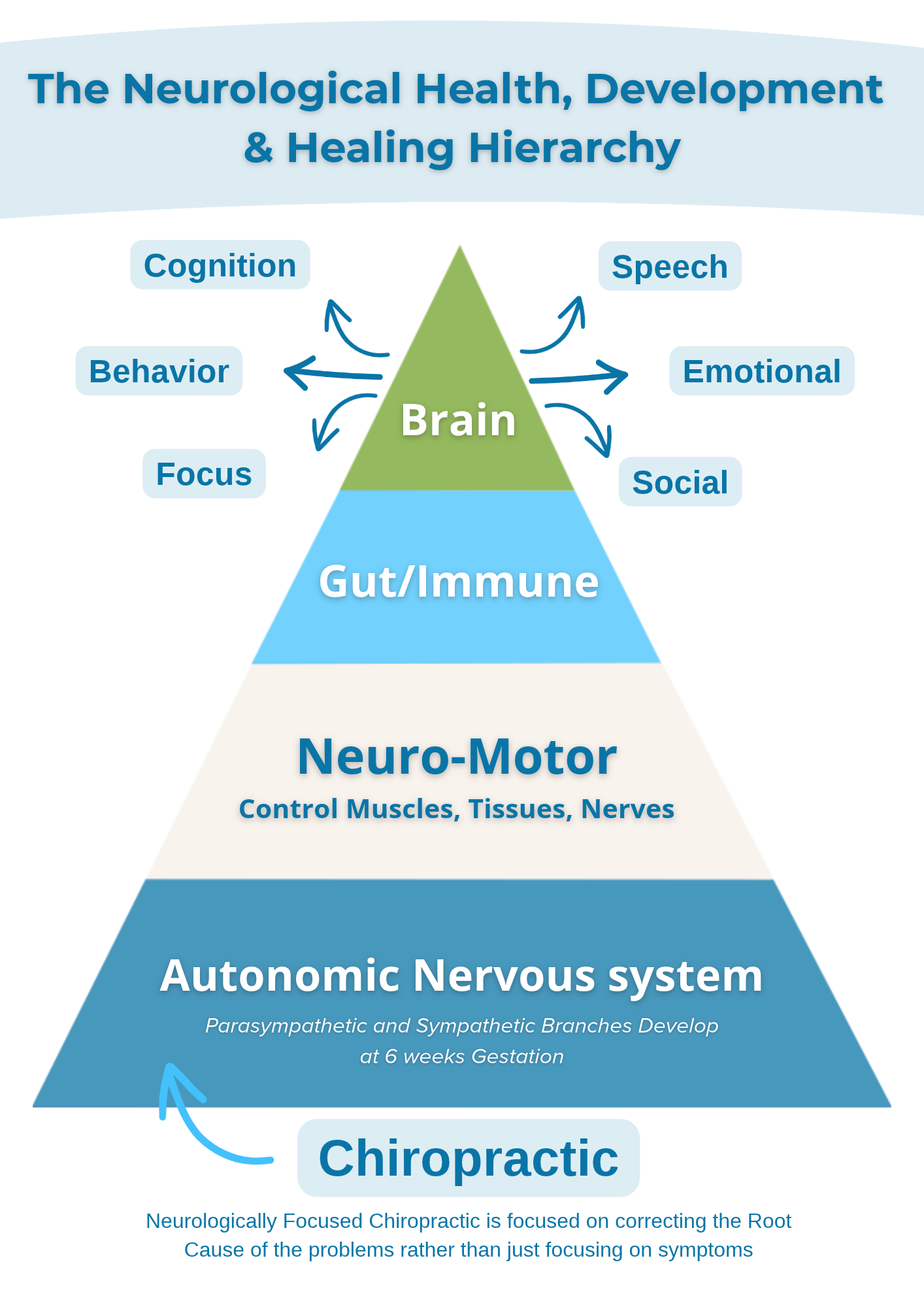
This is the picture I draw for parents. Start at the bottom and work up.
1. The base: the nervous system. Everything sits on this. The central and autonomic nervous system runs how your child senses the world, moves, digests, sleeps and handles stress. If the base isn't steady, everything above it has to work harder. This is where chiropractic care fits: supporting the nervous system so the rest of the pyramid has a solid foundation. (More in What is the vagus nerve?)
2. Movement: the neuromotor level. Next is how the body moves: balance, coordination, posture and getting the body working together. This is where OTs and paediatric physios do brilliant work, helping kids build these skills through movement and play.
3. The body: gut and immune system. Above that sits the gut and immune system, which a lot of parents already know is connected to the brain. Dietitians, naturopaths and GPs often support kids at this level, with things like nutrition and diet changes.
4. The top: the brain. At the top is everything we see: emotions, focus, behaviour, learning and speech. Speech pathologists, psychologists and teachers support kids here.
The pyramid isn't about one level being more important than another. Every level matters. It's about the order things build in. A child's brain is trying to do its best work on top of everything underneath it.
Why the whole team matters
No single practitioner covers the whole pyramid, and nobody should try to. The kids who do best usually have a team around them: their GP, their OT or speechie, their dentist, their teachers, and their family at the centre of it all.
My role is the base. I look after the nervous system, keep in touch with your child's GP and the other people in their corner, and make sure everyone's working together. When the people looking after a child talk to each other, the child is the one who benefits.
Want the full picture? Get the playbook
Our Family Playbook walks you through exactly how we look after kids in our practice: what happens at the first visit, what the scans measure, how we work with other practitioners, and simple things you can do at home.
Get the free Family Playbook Pop in your details and we'll send it straight to your inbox.
Quick questions
What does "body up, not brain down" mean? It means children's development builds from the foundations up: nervous system, then movement, then body, then brain. Supporting the lower levels helps give the top a solid base.
Does chiropractic replace OT or speech therapy? No. Every level of the pyramid matters, and we work alongside OTs, speech pathologists and other practitioners, never instead of them.
Where does chiropractic fit? At the base, supporting the nervous system, as part of your child's wider team.
